

Matrigma Test
What Is the Matrigma Test and How Do You Prepare?
The Matrigma Test is a cognitive ability assessment used by employers to measure a candidate’s logical reasoning, problem-solving skills, and general mental ability. Based entirely on non-verbal, abstract reasoning, the test presents visual patterns and requires you to identify the correct sequence or rule. It is commonly used in recruitment for roles that demand critical thinking and adaptability.
What is the Matrigma Test?
The Matrigma Test was created in the 1970s by Hans Jürgen Eysenck, a German psychologist known for his research on intelligence and personality. The name “Matrigma” is derived from the Latin words for “matrix” and “enigma.” It was designed to test cognitive skills such as mental speed, inductive reasoning, spatial visualization, and fluid intelligence – the ability to identify patterns and think logically, independent of acquired knowledge.
The test consists of 42 non-verbal, multiple choice questions to be solved within a 40 minute time limit. The questions take the form of abstract patterns or shapes that follow a logical progression or relationship. The test taker must identify the underlying logic and pick the correct choice to complete the pattern or sequence. For example, a question might show a series of shapes that change in a particular way over each step and the test taker must identify the next shape in the progression.
Abilities Assessed by the Matrigma
The Matrigma aims to measure three cognitive domains:
- Speed of mental processing – the ability to quickly perceive relationships, make logical connections, and arrive at the correct solution. Test takers have a limited time to answer each question, assessing their mental quickness.
- Inductive reasoning – the ability to identify logical rules, patterns and relationships in novel situations. Test takers must discern the underlying logic of each abstract sequence rapidly.
- Spatial visualization – the ability to mentally rotate shapes, identify patterns and process visual information. Many of the test items involve visual-spatial relationships.
In essence, the Matrigma provides insight into a person’s general fluid intelligence. According to experts, performance on the Matrigma correlates highly with IQ scores on standard intelligence tests. At the same time, it is considered culture-fair and language-neutral, making it accessible across different demographics.
Start practice today and improve your hiring chances
Three Full-Length Simulation Matrigma-Style
Timed Tests of 35 Questions Each
Usually, you will encounter one of two different versions of the assessment:
Classic Matrigma
This format is the most popular version of the test. It is also the longest, with a 40-minute time limit to answer 35 questions. As a result, you will have approximately 1:15 minutes to answer each question.
Remember that questions increase in difficulty as you progress throughout the test. However, note that they might be random easier (or harder) questions mixed in.
Adaptive Matrigma
Also known as Matrigma 2, this version includes a newer format of the traditional evaluation. As a result, it is less common. It consists of 40 questions to be answered in 12 minutes — leaving candidates with exactly one minute per item.
Given that this version is adaptive, the level of difficulty of the questions depends on the answer to the previous question. Hence, for every question you answer correctly, the following item will be harder. Thus, if you answer incorrectly, the next question will decrease in difficulty.
Lastly, you must know that the way the Matrigma Test scores are strictly confidential. Meaning you will only know if your score was ‘average,’ ‘below average,’ or ‘above average.’ Based on previous experiences, answering at least half of the questions correctly (18 to 20 over 40) will result in an ‘average’ score.
However, to successfully pass the assessment, you will need to be within the top 20%. So, be prepared as the Matrigma Test result is all about how many problems you were able to solve effectively within the given time constraint.
Start practice today and improve your hiring chances
How to Solve Matrigma Test Questions?
Here are some tips on how to solve Matrigma Test questions effectively:
- Read the instructions carefully: Make sure you understand the instructions and the format of the test before you begin. This will help you to manage your time effectively and ensure that you answer all of the questions within the allotted time frame.
- Focus on understanding the relationships between concepts: The questions on the Matrigma Test often involve identifying relationships between concepts and solving problems using logical reasoning. Focus on understanding the relationships between the concepts in the question and use deductive reasoning to arrive at the correct answer.
- Eliminate incorrect answers: If you are unsure about an answer, try to eliminate any options that you know are incorrect. This can help you to narrow down your choices and increase your chances of selecting the correct answer.
- Practice with sample questions: Practice with sample questions to familiarize yourself with the types of questions that may be included on the test. This can help you to build your problem-solving skills and improve your performance on the test.
- Manage your time effectively: The Matrigma Test is timed, so it is important to manage your time effectively. If you get stuck on a question, move on to the next one and come back to it later if you have time.
Classic vs Adaptive Matrigma
Not every employer uses the same Matrigma format. In general, Matrigma is a non-verbal cognitive test built around visual pattern recognition and abstract reasoning. The two formats most often discussed are Classic Matrigma and Adaptive Matrigma. Both are designed to measure reasoning ability, but they differ in structure, pacing, and overall test experience.
Classic Matrigma
Classic Matrigma follows a fixed structure. It is usually described as a longer test with a set number of questions presented in a planned order. In this format, every candidate moves through the same sequence, and the questions often become more difficult as the test goes on.
For many candidates, the classic version feels more predictable. You can settle into a rhythm and work through the test step by step. The challenge comes from maintaining concentration, managing time well, and handling harder matrix-style questions toward the end of the test.
Adaptive Matrigma
Adaptive Matrigma is a shorter and more dynamic version of the test. Instead of giving every candidate the exact same sequence of questions, the test adjusts difficulty based on performance. If you answer correctly, the next question may become harder. If you answer incorrectly, the next one may become easier.
This format usually feels faster and more intense because the test keeps responding to your performance in real time. Rather than following a fixed path, you are working through a test that is constantly estimating your ability level. For many candidates, that makes the adaptive version feel more pressured even though it is shorter.
Main Differences at a Glance
| Feature | Classic Matrigma | Adaptive Matrigma |
|---|---|---|
| Format | Fixed question order | Difficulty changes based on your answers |
| Test flow | Same sequence for everyone | Different path depending on performance |
| Length | Usually longer | Usually shorter |
| Difficulty pattern | Often becomes harder as you progress | Changes up or down during the test |
| Test feel | More steady and predictable | Faster and more dynamic |
Which Version Feels Harder?
That depends on the candidate.
Classic Matrigma may feel harder for people who find it difficult to stay focused over a longer timed test. Since the structure is fixed, the challenge often comes from building fatigue while still trying to solve increasingly difficult questions.
Adaptive Matrigma may feel harder for people who dislike time pressure or who feel stressed when the difficulty keeps changing. Because the test reacts to performance, strong candidates may quickly face more difficult items, which can make the experience feel intense.
How to Prepare for Both Versions
No matter which format you face, the best preparation strategy is similar:
- practice visual patterns and matrix-style questions
- improve speed without rushing blindly
- learn to identify common rule types such as rotation, sequence, shape change, and position change
- stay calm when a question looks unfamiliar
- avoid spending too long on one item
The main difference in preparation is pacing. For a classic version, endurance and time management matter more. For an adaptive version, quick pattern recognition and staying composed under pressure become even more important.
Classic Matrigma gives all candidates a fixed test path, while Adaptive Matrigma changes the difficulty level during the test based on how well you are doing.
Start practice today and improve your hiring chances
FAQ About the Matrigma Test
1. What is the Matrigma test?
The Matrigma test is a non-verbal cognitive assessment that measures abstract reasoning and problem-solving ability. It is designed to evaluate how well you recognize patterns, relationships, and logical rules in visual sequences.
2. What kind of questions are on the Matrigma test?
Most Matrigma questions show a series of shapes, figures, or patterns with one part missing. Your task is to identify the rule behind the sequence and choose the answer that completes it correctly.
3. Is the Matrigma test hard?
Many candidates find the Matrigma test challenging because it combines visual logic with time pressure. The difficulty often depends on how comfortable you are with pattern recognition, abstract reasoning, and solving unfamiliar problems quickly.
4. How can I prepare for the Matrigma test?
The best way to prepare is to practice matrix-style reasoning questions, improve your timing, and learn to spot common pattern types such as rotation, shape change, number progression, and position shifts. Regular practice can help you become faster and more accurate.
5. What does the Matrigma test measure?
The test is designed to measure general reasoning ability, especially abstract and logical thinking. Employers may use it to evaluate how quickly you can understand patterns, solve new problems, and think through unfamiliar information.
6. Is the Matrigma test the same as an IQ test?
Not exactly. The Matrigma test measures reasoning ability and problem-solving in a work-related assessment setting, but it is not the same as a full IQ test. It focuses mainly on non-verbal abstract reasoning.
7. How long is the Matrigma test?
The length can vary depending on the version used by the employer. Some candidates face a more traditional longer format, while others may see a shorter adaptive version. That is why it helps to prepare for both timing pressure and changing difficulty.
8. What is the difference between Classic and Adaptive Matrigma?
Classic Matrigma usually follows a fixed sequence of questions, while Adaptive Matrigma changes difficulty based on your answers during the test. The classic version often feels more predictable, while the adaptive version can feel faster and more intense.
9. Can I fail the Matrigma test?
The test is usually one part of a larger hiring process, so it is better to think of it as a performance measure rather than a simple pass or fail exam. Employers may compare your results with the level required for the role or with other candidates in the process.
10. What score is considered good on the Matrigma test?
A good score depends on the employer, role, and candidate pool. In general, a stronger score shows that you can recognize patterns accurately and work through abstract reasoning tasks efficiently under timed conditions.
11. Do employers really use the Matrigma test?
Yes, employers may use the Matrigma test as part of their pre-employment screening, especially for roles where reasoning ability, learning speed, and problem-solving matter. It may appear on its own or as part of a broader assessment process.
12. What is the best strategy during the Matrigma test?
A strong strategy is to look for the most obvious rule first, such as rotation, sequence, position change, or shape progression. Avoid spending too long on one question, keep moving, and stay calm if a pattern is not immediately clear.
Free Matrigma-Style Sample Questions
The questions below are designed to help you practice the kind of abstract and logical pattern recognition often seen in cognitive assessment tests. Focus on identifying the rule behind the pattern before looking at the answer. In most cases, the fastest way to improve is not guessing more quickly. It is learning how to spot the pattern in a more structured way.
Sample Question 1
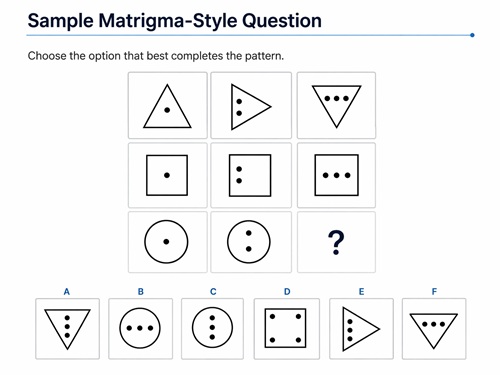
Choose the option that best completes the pattern.
Look at the 3×3 grid.
Across each row, the shape type stays the same, while the number of dots increases from 1 to 2 to 3.
The dot arrangement also changes from:
- one centered dot
- two vertical dots
- three horizontal dots
What should appear in the missing bottom-right box?
Answer options:
A. Inverted triangle with 3 vertical dots
B. Circle with 3 horizontal dots
C. Circle with 3 vertical dots
D. Square with 4 dots
E. Right-pointing triangle with 3 vertical dots
F. Inverted triangle with 3 horizontal dots
Correct answer:
B. Circle with 3 horizontal dots
Short explanation:
Each row keeps the same shape:
- Row 1 = triangles
- Row 2 = squares
- Row 3 = circles
Across the row, the number of dots increases from 1 to 2 to 3, and the dot layout changes in a consistent way.
So the missing figure must be a circle with 3 horizontal dots.
Sample Question 2
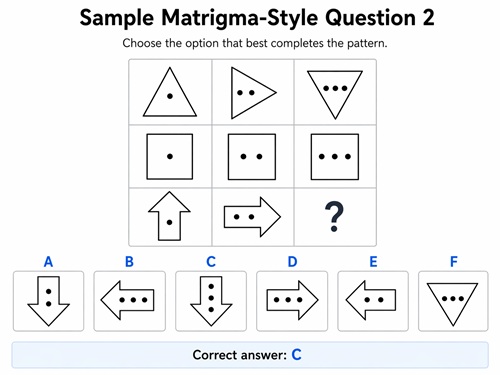
Choose the option that best completes the pattern.
Look at the 3×3 grid.
In each row:
- the shape stays the same
- the number of dots increases from 1 to 2 to 3
In each column:
- the position of the dots stays consistent
Pattern
Row 1
- Box 1: triangle with 1 centered dot
- Box 2: triangle with 2 dots on a diagonal
- Box 3: triangle with 3 dots in a row
Row 2
- Box 1: square with 1 centered dot
- Box 2: square with 2 dots on a diagonal
- Box 3: square with 3 dots in a row
Row 3
- Box 1: circle with 1 centered dot
- Box 2: circle with 2 dots on a diagonal
- Box 3: ?
Answer options
A. Circle with 2 dots in a row
B. Circle with 3 dots in a row
C. Circle with 3 dots on a diagonal
D. Square with 3 dots in a row
E. Triangle with 3 dots in a row
F. Circle with 4 dots
Correct answer:
B. Circle with 3 dots in a row
Explanation
Each row keeps the same shape:
- Row 1 = triangles
- Row 2 = squares
- Row 3 = circles
Across each row, the dots increase:
- 1 dot
- 2 dots
- 3 dots
So the missing figure must be a circle with 3 dots in a row.
Here is a shorter “real test” version:
Which option best completes the pattern?
A. Circle with 2 dots in a row
B. Circle with 3 dots in a row
C. Circle with 3 dots on a diagonal
D. Square with 3 dots in a row
E. Triangle with 3 dots in a row
F. Circle with 4 dots
Correct answer: B
Sample Question 3
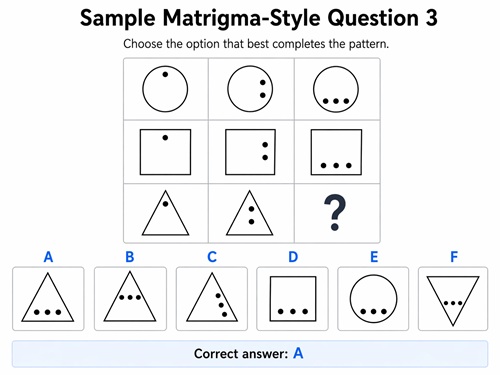
Explanation:
Each row keeps the same outer shape:
- Row 1 = circles
- Row 2 = squares
- Row 3 = triangles
Across the columns, the dot pattern changes in the same way each time:
- Column 1 = 1 dot at the top
- Column 2 = 2 dots vertically on the right side
- Column 3 = 3 dots horizontally along the bottom
So the missing figure must be an upright triangle with 3 dots along the bottom.
Correct answer: A